Reimagining an inclusive fashion future with The Right Fit

The Right Fit is a web app and browser extension designed to ask  "How should this garment fit you?" rather than "What size are you?". Users can build a personal fit profile from purchase history, read community data from people with similar fit patterns, and get recommendations in plain fit language rather than numeric verdicts. The body is no longer the object of evaluation; the garment is.
Team
Youlu Xu
Uraiba Zafar
My role
Designer
Research
Tools
Figma
Figma Make
Claude Design
Duration
1 month

The problem: A system to fix

Every day, millions of people open a browser to shop for clothes and encounter the same quiet moment of friction: choosing a size. For most shoppers, it is neither simple nor neutral. Selecting a size online requires a person to simultaneously interpret an inconsistent system, picture themselves against a model body, and make a judgment call about who they are relative to a standard that was never designed with them in mind. This friction is not incidental, it is produced by specific design choices.

As Kat Holmes argues in her Inclusive Design framework, the system's failure to account for the full diversity of bodies and preferences is not neutral: it is a mismatch, and mismatches produce exclusion.

The solution: The Right Fit

Our team designed The Right Fit as a first step to combat the emotional friction and feelings of inadequacy and doubt that is brought up by online shopping sizing methods. A web app and a browser extension, it draws upon aspects from Kat Holmes' Inclusive Design framework, Don Norman's emotional design principles, and Lisa Feldman Barrett's theory of constructed emotion to create a shopping experience for user's that is inclusive and emotionally aware.

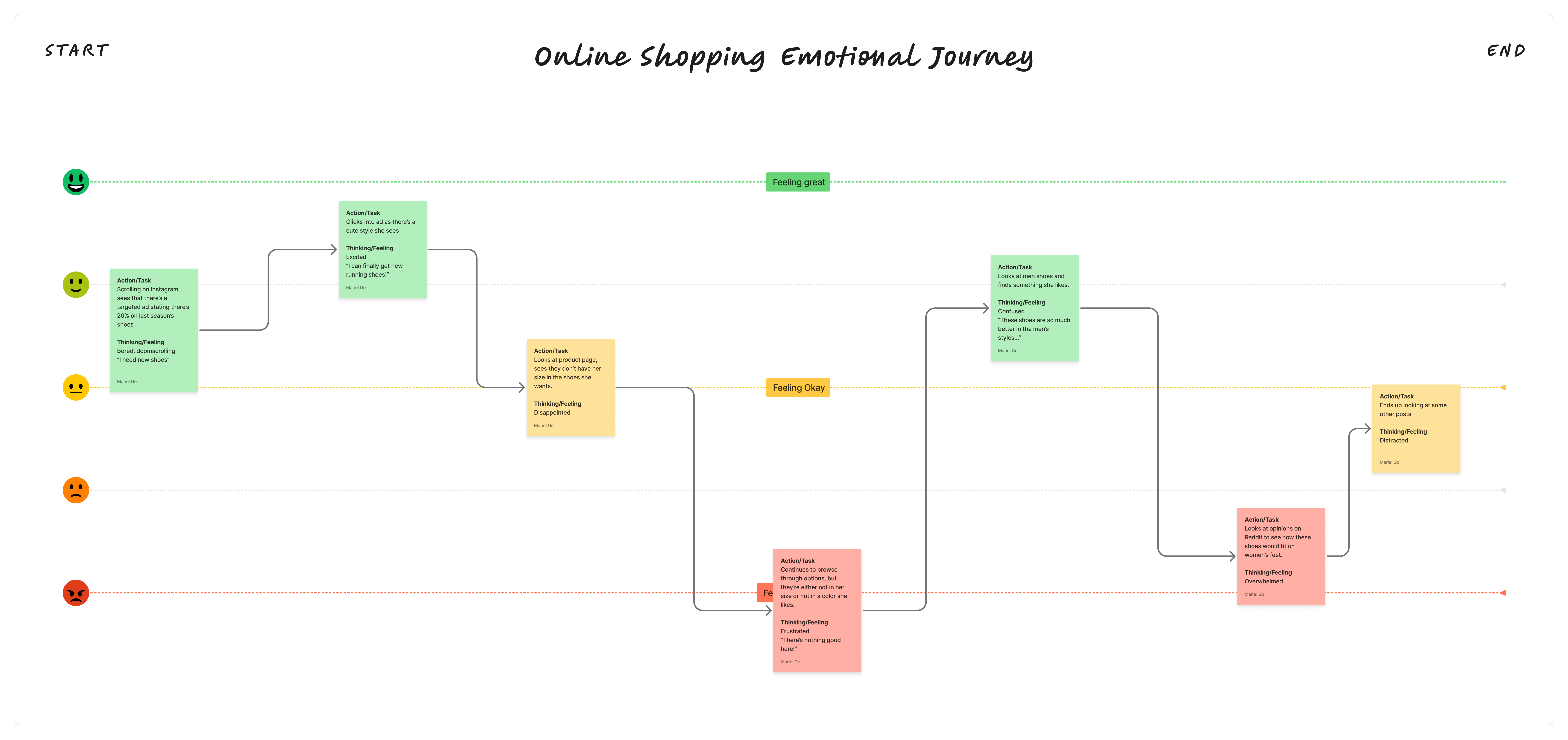
Setting the context via emotional journey mapping

To understand the lived experience of online shopping, we conducted six emotional journey mapping sessions, tracking emotional valence across the arc of a single shopping session. Near every session began with excitement, then was quickly disrupted by a sizing decision.
We noticed the following patterns across the maps:
  • Size chart and other tools such as model pictures and AI summaries are not useful at all. Instead, participants found workarounds like using Reddit or referencing reviews on other platforms.
  • There were lowered expectations on correct sizing or preferred fit, framing it as a calculated gamble or the cost of shopping online.
  • Flexible return policies changed the emotional tone entirely. When the cost of being wrong dropped, so did the anxiety.
So we knew that our experience should:
  • Display crowdsourced reviews that reflect user's intended fit and style
  • Use language that doesn't place blame on the user
  • Offer transparent information on returns and other retailer information

First phases to creating an emotionally-aware design

The first iteration

Based on desk research, the emotional journey mappings, and with some ideation help using Figma Make and Claude, we designed the first version of The Right Fit.
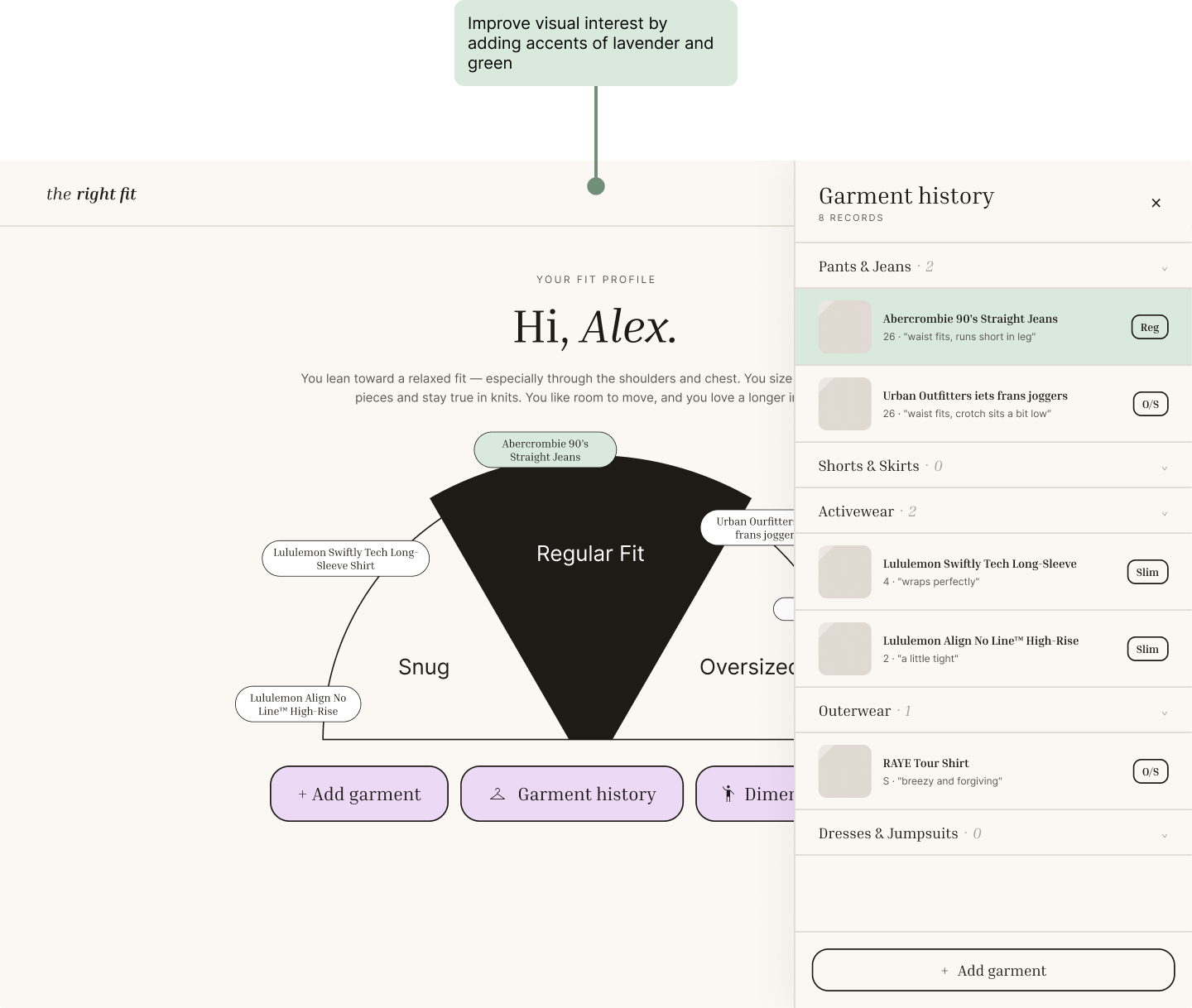
The web app of The Right Fit:
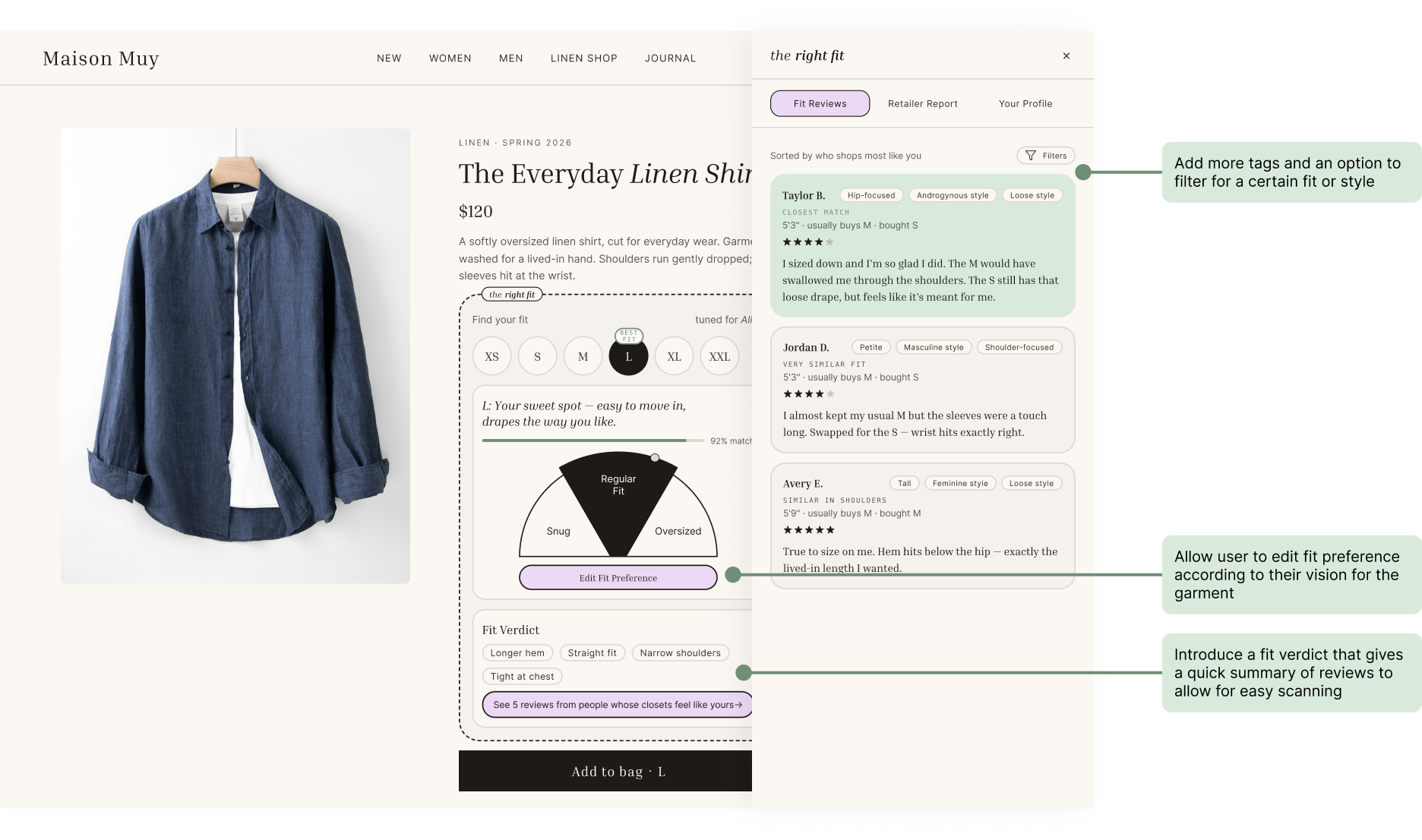
The browser extension of The Right Fit:

Uncovering points of emotional friction through cognitive walkthroughs and inclusive personas

To evaluate the prototype, we conducted 3 cognitive walkthroughs focused on emotional friction rather than functional learnability, asking participants to narrate what they were feeling at each screen of the experience. A few pieces of feedback we received were:
  • To redesign the Fit Meter language, as "slim" doesn't make sense
  • To improve visual interest to make it seem less like a clinical sizing utility
  • Include the sizing verdict on the overlay for a more cohesive experience
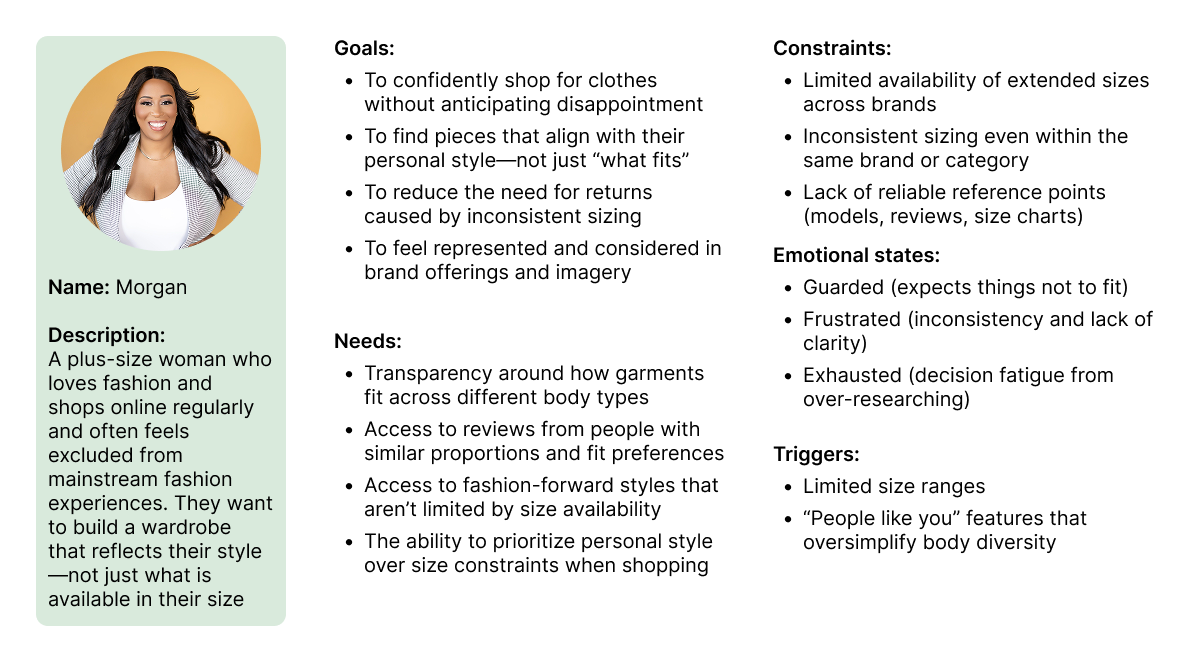
We also wanted to address a missing element from our initial context setting phase: diversity in bodies and styles. Our participants so far have ranged in body sizes and styles, but not to a great extent. So, we created inclusive personas to help us think through what improvements could be put in the next iteration of our experience.
Based on the needs, goals, and constraints presented from our personas, we knew that we wanted to introduce:
  • Neutral and inclusive language, especially in the browser extension overlays
  • The ability to update garment information

An inclusive and improved design

Our final iteration introduced new features and improved content based on the feedback received from the cognitive walkthroughs and ideas generated from our inclusive personas.

Reflections on the impact of our design

A tricky risk

The app's core tension is that its value depends on the data users are willing to share, yet the people who would benefit most are often the least likely to share it. Barrett's theory of constructed emotion helps explain why: users who have been repeatedly failed by mainstream retail arrive carrying a body of negative predictions, expecting this experience to replicate past ones. That expectation of failure is itself a barrier to engagement, meaning the app must actively interrupt those predictions before asking for vulnerability. On an individual level, reluctance to disclose sensitive information weakens the prediction engine, meaning the system serves confident, open users better than cautious or vulnerable ones.

This dynamic scales into a broader societal problem: if community contribution skews toward users already well-served by mainstream retail, the data that powers the app will quietly reinforce the same inequalities the product is trying to address.

Real limitations worth addressing

Our testing process was unable to recruit participants most acutely sensitive to body image and sizing issues, meaning our insights likely underrepresent the users this project most needs to design for.

Real-world implementation would also face structural resistance: retailers would need to restructure how sizing is presented on product pages, and the system's value depends on brands providing more honest and inclusive sizing data than most currently offer.

It is also worth being clear about what this app can and cannot do. Sizing and body aesthetic culture is a structural problem rooted in culturally constructed ideas about bodies and beauty, and in a manufacturing industry that has historically excluded large portions of the population.

A more inclusive fit system addresses a genuine pain point, but it is ultimately a painkiller for a symptom rather than a cure for the condition. What it can do is refuse to profit from that culture, be transparent about its limits, and remain as emotionally sensitive as possible to the people navigating it. We took to treating every design decision as an opportunity to do slightly less harm than the systems that came before it.